Workplace violence is a serious problem that can have devastating consequences for both employees and employers. In 2019, there were over 2 million cases of workplace violence in the United States, resulting in over 2 million lost workdays and $17 billion in lost productivity.
According to the Occupational Safety and Health Administration (OSHA), workplace violence is any act or threat of physical violence, harassment, intimidation, or other threatening behavior that occurs in the workplace. Workplace violence can lead to serious injuries, fatalities, and long-lasting psychological trauma.
In this article, we’ll explore some of the workplace violence statistics and how it can be prevented with background checks. While there is no surefire way to prevent workplace violence, there are steps that employers can take to reduce the risk. One of the most effective tools is background checks.
Workplace Violence Statistics
According to the National Safety Council (NSC), more than 18,000 workers in the United States experienced nonfatal workplace violence injuries in 2019. Additionally, the Bureau of Labor Statistics (BLS) reports that in 2020, there were 774 workplace homicides, accounting for 9% of all fatal workplace injuries. The BLS also notes that healthcare and social assistance workers are at the greatest risk of workplace violence, accounting for nearly 73% of all nonfatal workplace violence incidents.
How Background Checks Can Help Prevent Workplace Violence
Background checks are a vital tool in preventing workplace violence. By conducting thorough background checks on potential employees, employers can identify any red flags or warning signs of violent behavior. Here are some ways in which background checks can help prevent workplace violence:
Background checks can help employers identify potential risks by screening for criminal history, driving records, and other relevant information. This information can be used to make informed decisions about hiring and placement.
For example, an employer may choose not to hire an applicant with a history of violent crime or drug abuse. Or, an employer may choose to place an employee in a different position if they have a history of driving under the influence.
Criminal History Checks: Employers can conduct criminal history checks on potential employees to identify any past incidents of violent behavior. This can include convictions for assault, battery, or domestic violence.
Employment Verification: Employers can verify a potential employee’s previous employment history to ensure that they have not been dismissed for violent or threatening behavior.
Reference Checks: Employers can conduct reference checks on potential employees to obtain insights into their personality, work habits, and behavior. References can provide valuable information about an individual’s temperament and propensity for violence.
Here are some additional tips for using background checks to prevent workplace violence:
Use a reputable background check company. Not all background check companies are created equal. Make sure to choose a company that is accredited by the Professional Background Screening Association (PBSA).
Be aware of the laws in your state. There are some restrictions on what information can be used to determine an applicant’s eligibility for a job position in a background check. Be sure to check the laws in your state before you conduct a background check.
Be prepared to take action. Once you have conducted a background check and identified a potential risk, be prepared to take action. This may mean not hiring an applicant or placing them in a different position.
By following these tips, you can use background checks to help prevent workplace violence and create a safer workplace for everyone.
Hiring practices are constantly evolving, but in the 30+ years SELECTiON.COM® has been in business, background check usage by companies has been and continues to be on the rise. Background checks are still the most effective way of taking reasonable precautions to create a safe work environment for your employees and minimize costly turnovers. In addition, new reporting methods continue to make background checks more effective and reliable year after year.
Contact us today to see how SELECTiON.COM® can improve your background check process.
This article gives a general overview of legal matters. However, it is your responsibility to ensure compliance with all the relevant federal, state, and local laws governing this area. SELECTiON.COM® does not provide legal advice, and we always suggest consulting your legal counsel for all applicant approval matters.
This article is provided for information purposes only, and the contents hereof are subject to change without notice. This article is not warranted to be error-free nor subject to any other warranties or conditions, whether expressed orally or implied in law, including implied warranties and conditions of merchantability or fitness for a particular purpose.
Hiring Nightmares Part 4: The Fraudulent Salesperson
The stories presented in the “Hiring Nightmares” series are entirely fictional and created for illustrative purposes. Any similarities to actual companies, individuals, or events are purely coincidental and unintentional. These scenarios are designed to highlight the importance of thorough background checks and the potential risks of inadequate screening. Readers should not interpret these stories as real-life events or representations of specific businesses.
Hiring Nightmares Part 3: The Fraudulent Salesperson
The stories presented in the “Hiring Nightmares” series are entirely fictional and created for illustrative purposes. Any similarities to actual companies, individuals, or events are purely coincidental and unintentional. These scenarios are designed to highlight the importance of thorough background checks and the potential risks of inadequate screening. Readers should not interpret these stories as real-life events or representations of specific businesses.
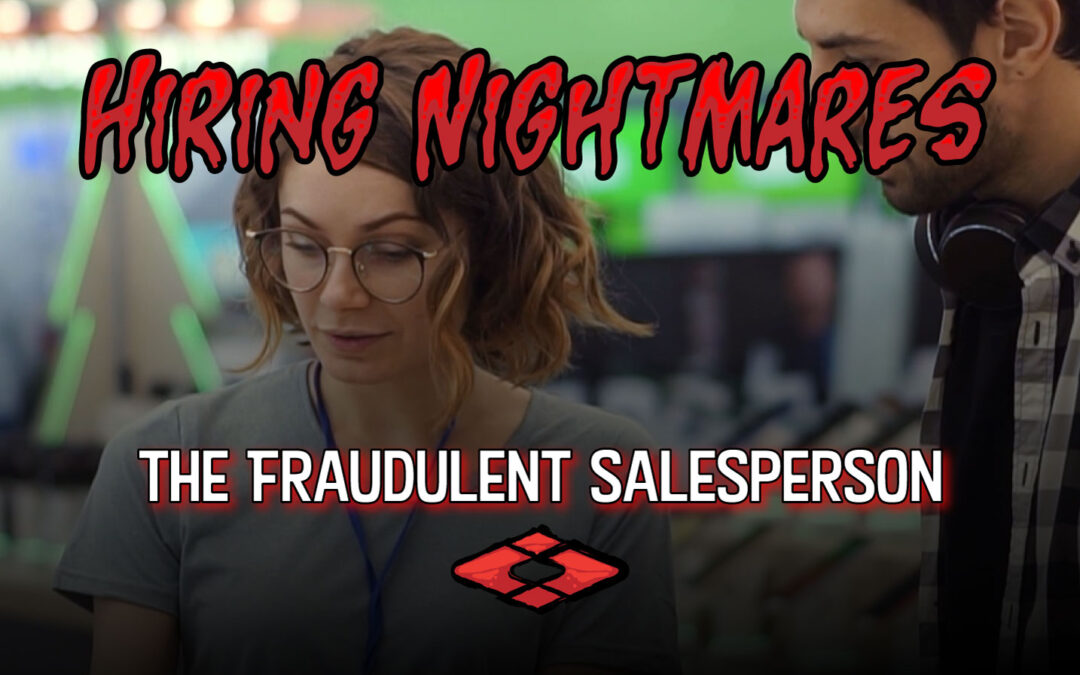
The Salesperson Who Used the System to Steal from the Company
The electronics store was expanding fast, and they needed a top-notch salesperson to lead the charge in their flagship location. Specializing in high-end smartphones and electronics, the store prided itself on offering quality products and service. When Erin applied for the position of Sales Lead, she seemed like a dream candidate. With a strong resume, years of experience, and a reputation for driving sales, she impressed Diane, the Store Manager, and Carlos, the Regional Sales Director. Erin was hired quickly, and in their excitement, they skipped a comprehensive background check.
At first, Erin was a star. She brought energy and enthusiasm to the sales floor, motivated her team, and seemed to know exactly how to connect with customers. Her numbers were impressive, and Lily, the Assistant Manager, frequently praised Erin’s ability to hit ambitious sales targets. Customers loved her too—she knew the products inside and out and made everyone feel valued and supported.
But after a few months, Tom, the Finance Manager, noticed unusual patterns in the store’s inventory and sales reports. High-end electronics, particularly the latest smartphones, seemed to be moving at an unusually fast pace, with an equally high volume of returns. But these returns often didn’t align with sales trends, and the repeated return transactions raised a red flag.
Suspicious, Diane decided to investigate further. She reviewed recent transactions and noticed a recurring pattern: certain customers, often young men who Erin seemed particularly friendly with, were purchasing the latest models in bulk, only to return a portion of them shortly after. She pulled security footage and confirmed her suspicions—Erin was engaging in a scheme involving her friends.
Here’s how it worked: Erin’s friends would come into the store and buy the latest phones or electronics, with Erin ringing them up at the register. Instead of giving them the one or two items they’d purchased, Erin would sneak them an extra item or two. The friends would then return only part of the merchandise a few days later, with Erin processing the return as if it were a standard transaction. Meanwhile, they’d sell the extra electronics online and split the profits with Erin. It was an elaborate scheme, and they’d managed to siphon thousands of dollars’ worth of merchandise from the store in just a few months.
A quick background check would have revealed Erin’s previous involvement in a similar fraud scheme at a prior retail job. She had been terminated but managed to keep the incident off her resume, and the hiring team’s rushed process meant her past went unexamined.
The fallout was severe. In the short term, the company faced significant financial losses and had to implement stricter inventory and return protocols. Diane had to manage a frustrated team, who felt betrayed by their once-beloved leader. Erin was, of course, terminated and faced criminal charges, but the damage was done. In the long term, the store’s reputation took a hit, and customer trust needed to be rebuilt. The company invested in additional security measures, revamped their hiring policies to include comprehensive background checks, and doubled down on staff training.
Conclusion:
A simple criminal background check would have flagged Erin’s prior involvement in retail fraud, saving the company from financial loss and reputation damage. SELECTiON.COM® offers thorough background screening services, including criminal history checks, to help protect your business from hiring risks. Don’t let a single bad hire undermine your company—partner with SELECTiON.COM® to make informed, secure hiring decisions.
The stories presented in the “Hiring Nightmares” series are entirely fictional and created for illustrative purposes. Any similarities to actual companies, individuals, or events are purely coincidental and unintentional. These scenarios are designed to highlight the importance of thorough background checks and the potential risks of inadequate screening. Readers should not interpret these stories as real-life events or representations of specific businesses.
The stories presented in the “Hiring Nightmares” series are entirely fictional and created for illustrative purposes. Any similarities to actual companies, individuals, or events are purely coincidental and unintentional. These scenarios are designed to highlight the importance of thorough background checks and the potential risks of inadequate screening. Readers should not interpret these stories as real-life events or representations of specific businesses.
The Warehouse Manager Who Stole More Than Just Time
It was supposed to be a routine hire. The growing manufacturing company had expanded rapidly and needed a dependable manager to oversee their bustling warehouse. The position had been vacant for a few months, so when Tom, a seasoned warehouse manager, applied for the role, it seemed like the perfect match. With over 15 years of experience and glowing references, Sarah, the company's HR Manager, was eager to get him on board quickly.
The Operations Director, Mark, felt confident in the hire and was impressed with Tom’s background in logistics and team management. In their rush to fill the position, they skipped a full background check, relying on Tom’s impressive resume and charming interview presence.
Within the first few months, Tom quickly made his mark. He reorganized the warehouse, streamlined inventory processes, and implemented new systems that seemed to reduce errors and delays. The team loved him—he was firm but fair, and always had a solution when things got hectic. The Warehouse Supervisor, Greg, praised Tom’s leadership, saying that productivity had improved under his direction. The management team was thrilled. It looked like they had found the perfect person for the job.
But soon after, the inventory reports started showing inconsistencies. At first, it was small discrepancies—minor items missing from shipments that could be chalked up to human error or misreporting. The finance department, led by Laura, noticed that the missing items weren't random but seemed to always involve higher-value goods. But with such a busy warehouse and a high volume of daily shipments, these inconsistencies didn’t immediately raise alarms.
As the weeks went on, the missing items began to add up, and the losses became significant. Sarah, still confident in Tom, attributed the errors to the warehouse's rapid growth and assured the team they would sort it out. But Greg grew suspicious. He’d noticed that Tom frequently stayed late, often working alone after the rest of the staff had left. What seemed like dedication at first now seemed unusual, especially considering the mounting losses.
Greg quietly reviewed security footage from after-hours shifts, and what he found was shocking. The footage revealed Tom sneaking high-value products out of the warehouse and loading them into his own vehicle. He had been orchestrating an elaborate scheme, using his access as warehouse manager to siphon inventory out under the radar. With control over the inventory system, he manipulated records to hide his theft for months.
The revelation sent shockwaves through the company. In total, Tom had stolen thousands of dollars in goods—everything from electronics to machinery parts. A simple criminal background check would have revealed that Tom had a prior conviction for theft at a previous employer. But with the hiring process rushed, the company had skipped this critical step and paid the price.
In the short term, the company faced immediate financial losses and had to spend significant resources investigating how far the theft went. They lost inventory, time, and trust within the warehouse team. Employees, once loyal to Tom, felt betrayed, and morale plummeted. In the long term, the company had to overhaul its inventory management system, invest in new security measures, and rebuild a team that had been shaken by the ordeal.
Tom was, of course, fired and faced criminal charges. But the damage had already been done. The company spent months picking up the pieces—both in terms of physical inventory and the trust of their employees.
Conclusion:
A simple criminal background check could have prevented this disaster. Don’t leave your business vulnerable to theft or dishonesty. SELECTiON.COM® offers comprehensive background screening services, including criminal history checks, to ensure you hire trustworthy employees. Protect your company before it’s too late—partner with SELECTiON.COM®for all your background check needs.
Hiring Nightmares Part 2: The IT Saboteur – A Tech Industry Horror Story
The stories presented in the "Hiring Nightmares" series are entirely fictional and created for illustrative purposes. Any similarities to actual companies, individuals, or events are purely coincidental and unintentional. These scenarios are designed to highlight the importance of thorough background checks and the potential risks of inadequate screening. Readers should not interpret these stories as real-life events or representations of specific businesses.